As wind energy projects grow in scale and capital intensity, the accuracy of energy yield assessments has become a critical concern for developers, lenders, and public authorities. Any deviation from actual performance can materially affect project financial viability.
Why energy yield assessments are uncertain
Energy yield assessments are prone to many sources of uncertainties, inlcuding:
- Wind measurement uncertainty
- Long-term extrapolation uncertainty
- Horizontal and vertical extrapolation uncertainties depending on terrain, climatic conditions and modelling approaches
- Uncertainty related to the expected turbin and wind farm performance
In practice, uncertainty on the end-result of energy yield assessments typically ranges between 8% to 14% depending on the project characteristics. Although models continue to improve, uncertainty remains significant.
Methodological differences between energy consultants: a hidden source of risk
The unquantified self-estimated uncertainties of the consultant
A frequently underestimated source of uncertainty lies in the choice of the consultant and applied methodology. This variability is generally not quantified and is usually assumed to be embedded in the consultant’s own uncertainty estimates.
Danish Technical University (DTU) proficiency test highlights variability in energy yield estimates
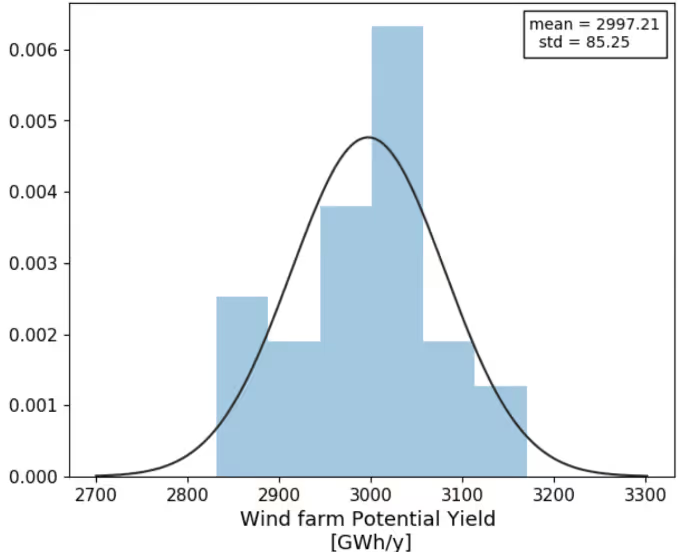
To evaluate this effect, the Danish Technical University (DTU) organised a proficiency test[1]. 28 participants (consultants and project developers), including 3E, submitted production estimates for the 659 MW Walney 3 & 4 offshore wind farm.
The results showed (see Figure 1):
- A relatively low standard deviation (~3%)
- Yet more than 10% difference between the most conservative and most optimistic results (which is comparable to the uncertainty usually assigned to offshore energy yield assessments).
This raises critical questions for the industry:
- How reliable are experts’ self-estimated uncertainties?
- Should industry-wide standardisation and methodologies be strengthened?
Standardisation as a risk mitigation tool in wind energy development
IEC, MEASNET and FGW: harmonising technical methodologies
To improve consistency and comparability, the wind industry has established a suite of standards and methodological guidelines. Prominent examples include:
- IEC 61400-50 series
- MEASNET evaluation guidelines
- Germany’s FGW TR6 (commonly referred to as TG6)
These best practices define how wind resource measurements and energy yield assessments should be conducted.
The widespread adoption of these frameworks has significantly reduced development risk by harmonising methodologies, assumptions, and reporting practices across the sector.
ISO 17025: embedding quality and traceability
While IEC, MEASNET, and FGW specify technical methodologies, ISO 17025 governs the quality framework under which these activities are performed.
ISO 17025 is the international standard for competence, impartiality, and consistent operation of testing and calibration laboratories. Being ISO 17025 accredited confirms that the organisation performs its activities in a controlled, documented and traceable way.
Why ISO 17025 accreditation matters for project finance
In wind resource assessment and related technical services, accreditation to ISO 17025 provides independent verification that data acquisition, processing and validation follow documented, auditable procedures, aligned with recognised industry methodologies.
For lenders and investors, this institutionalised quality assurance provides confidence not only in the methods applied, but also in the rigor and governance of the entire process.
As a result, ISO 17025 accreditation, specifically when scoped to relevant wind measurement and energy yield assessment activities, is increasingly referenced in:
- Tender specifications
- Lender technical advisor requirements
- Regulatory frameworks across multiple markets
Standardisation helps minimise these risks by ensuring that technical results are reproducible, traceable and comparable across projects, markets and consultans. However, standards only create value when they are applied rigorously and consistently in practice.
From theory to practice: ensuring reliable wind measurement data
In real-world projects, the reliability of wind measurement data can vary significantly depending on how strictly best practices are followed during installation, monitoring, and data processing.
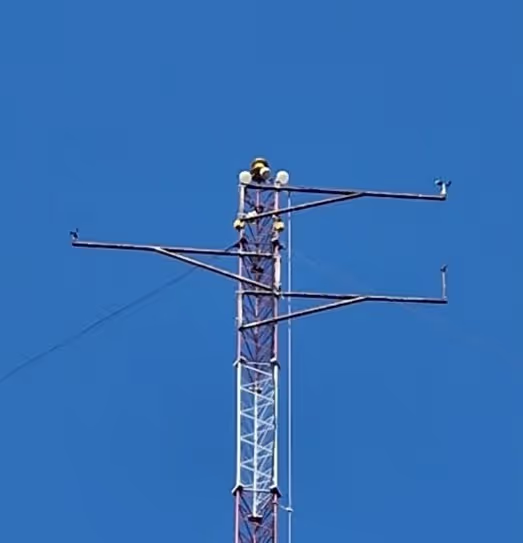
Seemingly minor technical details, such as boom length, mast configuration or sensor placement, can affect data quality. Where controls are absent or inconsistently applied, data quality issues and methodological discrepancies occur more frequently, increasing uncertainty and project risk.
Execution quality, therefore, directly influences bankability and investor confidence.
ISO 17025 and global quality standards in international wind projects
The relevance of accredited approaches extends far beyond Europe. 3E has contributed technical expertise to projects developed under internationally recognised, programmes, ensuring consistent application of standards and best-practice guidelines. These projects include:
- South Africa’s Renewable Energy Independent Power Producer Procurement Programme (REIPPPP)
- IFC’s Scaling Wind Programme[2]
- The World Bank’s Energy Sector Management Assistance Program (ESMAP)
By applying rigorous standards and accredited processes in these programmes, 3E helped support transparent project evaluation and secure international financing.
3E’s commitment to accredited and standardised wind resource assessment
As an international renewable energy consultancy and software company, 3E delivers technical advisory and analytics services across the full wind project lifecycle.
Acting as an independent expert across a broad portfolio of projects and markets, 3E is routinely exposed to the full spectrum of industry practice: from exemplary implementations, to installations where seemingly minor deviations from best practice can materially affect data realiabilty (Figure 2).
This practical experience has reinforced a central conclusion: rigorous and transparent processes are essential to minimise uncertainty at its source.
To formalise this committment, 3E recently obtained ISO 17025 accreditation, underscoring its dedication to:
- Standardised methodologies
- Measured traceability
- Data integrity in wind resource assessment
For developers, lenders, and investors, this provides independent assurance that 3E not only understands international standards, but applies them rigorously in the field, reducing uncertainty and strengthening project bankability.
References:
[2] International Finance Corporation. (n.d.). Scaling Wind. World Bank Group