Led by Irish technology company SuperNode and funded through Belgium's Energy Transition Fund, the STERNA 2050 project brought together industrial and academic expertise to assess future offshore energy developments and the technologies required to support their integration into the grid.
The North Sea is set to become the renewable powerhouse of Europe in the coming decades. Offshore wind ambitions continue to grow across Belgium, Denmark, France, Germany, the Netherlands, Norway and the United Kingdom, creating the need for transmission infrastructure capable of transporting significantly larger amounts of renewable power from offshore projects to consumers onshore. This unprecedented development strategy creates a complex landscape where the rapidly increasing density of offshore wind parks raises critical concerns about potential wind resource competition and farm-to-farm interactions across Exclusive Economic Zones.
As part of this collaborative initiative involving Supernode, DEME, Umicore, KU Leuven, and the Belgian Federal Public Service (FPS) Economy, which established the Energy Transition Fund (ETF) that financed the STERNA project, 3E contributed its expertise in development scenario analysis, offshore technology trends, and power production modelling.
This work supported the assessment of future power transmission solutions, including the potential of SuperNode's superconducting transmission technology. As conventional subsea cables are currently limited to around 1 GW per cable, superconducting technology could enable significantly larger amounts of renewable electricity to be transmitted through fewer connections.
By combining expertise from different organisations and countries, STERNA 2050 contributed to a deeper understanding of how offshore renewable energy systems combined with cutting-edge transmission technologies can support the North Sea’s green power expansion to accelerate Europe's energy transition.

Mapping offshore wind developments up to 2050
A key part of 3E's contribution was to thoroughly map the offshore wind buildout across the North Sea basin through 2050.
The work combined information on operating wind farms, projects under construction, planned developments, concession areas and national offshore wind targets to provide coherent expansion trajectories of how offshore generation is likely to evolve across the region. Based on this information, 3E produced annotated maps illustrating offshore wind developments in 2030, 2040 and 2050.

To account for the inherent uncertainty due to the large time horizon, three development scenarios were defined:
- The low development scenario assumes that all operating wind farms remain in service, projects currently under construction are completed, and only a limited share of planned projects and future development areas are realised. Under these assumptions, offshore wind capacity continues to grow, but at a slower pace than current ambitions suggest, with expansion largely tapering off after 2040.
- The expected development scenario reflects the most likely outcome based on the information available today. It assumes that the majority of planned projects move forward and that a significant share of future development areas are brought into operation. As a result, offshore wind capacity continues to expand steadily across the North Sea, with most countries moving close to their long-term ambitions, although some targets remain only partially achieved.
- The high development scenario represents a more ambitious outlook in which all currently announced targets are achieved and additional areas identified through marine spatial planning are developed for offshore wind. This results in the highest level of installed capacity across the North Sea and illustrates the scale of growth that could be achieved if policy ambitions, planning frameworks and project delivery remain closely aligned.
Together, these scenarios provide a structured view of how offshore wind may develop under different assumptions. This helps to create a common basis for assessing future technologies, estimating energy production and evaluating the transmission infrastructure required to support offshore wind growth over the coming decades.
Assessing the technologies shaping future offshore energy
Alongside this analysis, 3E assessed how offshore renewable technologies are expected to develop up to 2050, providing a realistic set of assumptions for the power system modelling performed in the STERNA 2050 project.
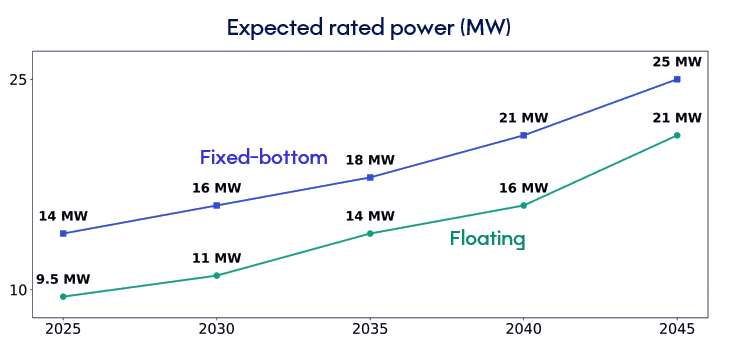
The assessment identified a continued move towards larger offshore wind turbines, with fixed-bottom turbines expected to reach around 25 MW and floating turbines around 21 MW for projects installed from 2045 onwards. Floating wind was also identified as an increasingly important technology, enabling offshore wind development in deeper waters that are unsuitable for conventional foundations. Together, these trends are expected to increase energy production whilst reducing the number of turbines required for the same installed capacity.
Beyond offshore wind, 3E evaluated several complementary renewable technologies. The analysis concluded that floating solar and tidal energy have the strongest potential to support future offshore energy systems in the North Sea, whilst wave energy, airborne wind energy and ocean thermal energy conversion (OTEC) are unlikely to play a significant role within the timeframe considered.
The study also explored three future scenarios for offshore green hydrogen production and the impact each could have on energy transmission. The first assumes no offshore hydrogen production, with all electricity exported to shore via the grid. The second introduces targeted hydrogen production, where around 20% of offshore wind capacity located more than 100 km from shore and commissioned after 2040 exports energy as hydrogen, helping to reduce pressure on the electricity network. The third increases this share to 50% of eligible capacity, illustrating how greater adoption of offshore hydrogen could further ease transmission requirements. This scenario would however require substantial investment in hydrogen infrastructure, and appropriate supporting policies.
Detailed power production modelling across the North Sea
Building on the development scenarios and technology assessment, 3E simulated turbine-level hourly power production time series for each of the nine offshore wind expansion scenarios, covering the three development pathways for 2030, 2040 and 2050. This enabled different levels of offshore wind deployment across the North Sea to be assessed using a consistent methodology. Rather than estimating annual energy production alone, the modelling approach captures realistic variability of the power output throughout the year, creating rich datasets for future transmission studies and wider electricity system planning.
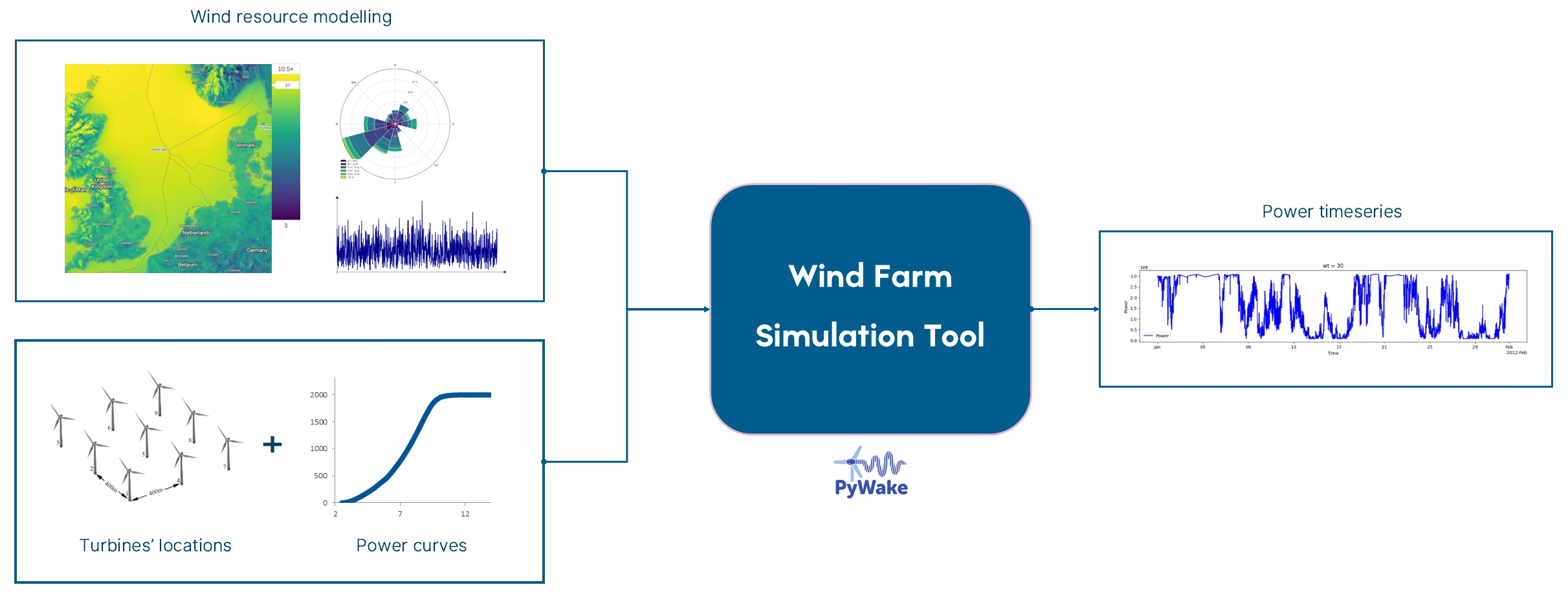
To ensure meaningful comparisons, the modelling adopted a Typical Meteorological Year (TMY) approach. Long-term wind resource data was used to create a representative weather year that reflects typical seasonal and daily wind patterns, providing a consistent meteorological baseline across all scenarios.
3E’s simulations accounted for the key factors affecting offshore wind farm performance, including internal wake losses, external wake losses, turbine downtime and electrical losses. Farm-to-farm wake interactions were calculated as hourly time series using the TurbOPark engineering wake model, allowing external wake effects to be represented dynamically as offshore wind development expands across the North Sea. The methodology was also validated against operational offshore generation data, providing confidence that the simulated results closely reflect expected real-world performance.
Applying this modelling to the low, expected and high development scenarios described earlier highlighted the range of possible outcomes for North Sea offshore wind. By 2050, installed capacity ranges from around 170 GW in the low development scenario to more than 300 GW in the high development scenario, with annual electricity generation increasing from approximately 734 TWh (low development) to 1,328 TWh (high development).

Despite this increasing density of offshore wind farms, average wind farm performance can be expected to remain relatively stable, as higher-capacity turbines allow greater spacing and help offset additional wake losses.
Supporting the future of offshore renewable energy
The STERNA 2050 project highlights the importance of combining long-term planning with detailed engineering analysis to prepare for the next generation of offshore wind and transmission infrastructure.
Through regional scenario development, technology assessments and advanced power production modelling, 3E helped create a robust technical foundation for evaluating future offshore transmission solutions and supporting the continued expansion of offshore wind across the North Sea.
Get in touch with our experts involved in the STERNA project
Interested in learning more about the research and its findings? Connect with the 3E experts who contributed to the STERNA project to discuss the study, explore its implications for the offshore energy sector, and gain insights into the future of integrated offshore energy systems.