Germany has become one of the most attractive battery storage markets in the world and, at the same time, one of the hardest to connect to. By 2025, grid connection applications for battery storage had passed 720 GW against roughly 78 GW of confirmed connection commitments. Capital is abundant, but access to the grid has become the biggest challenge. To help address this challenge, Germany introduced the Flexible Connection Agreement (FCA) into law on 25 February 2025 and became the default route to connection through 2026. For independent power producers building BESS portfolios, projects without an FCA are, in practice, no longer viable, the queue is simply too congested.
An FCA is usually described in commercial terms: a “fast pass” that trades a share of revenue for years saved in the connection queue. That framing is correct but incomplete. An FCA is first and foremost a set of technical operating constraints, and its true cost is decided by how well your asset performs inside them. This article is a practical, technically grounded guide to what FCAs do to a battery, how those constraints translate into lost — or recovered — revenue, and how to navigate them with the least damage to the business case.
What an FCA actually is
An FCA provides non-firm grid access, meaning a project can connect to the network but may face temporary operating restrictions when the grid is congested. Instead of waiting years for full grid reinforcement, the asset connects sooner and cheaper on the condition that the grid operator can curtail or reshape its behaviour when the local network is stressed. These conditions can be grouped into four main categories, and each one can affect a project's revenue in different ways. Together, their impact can be significant:
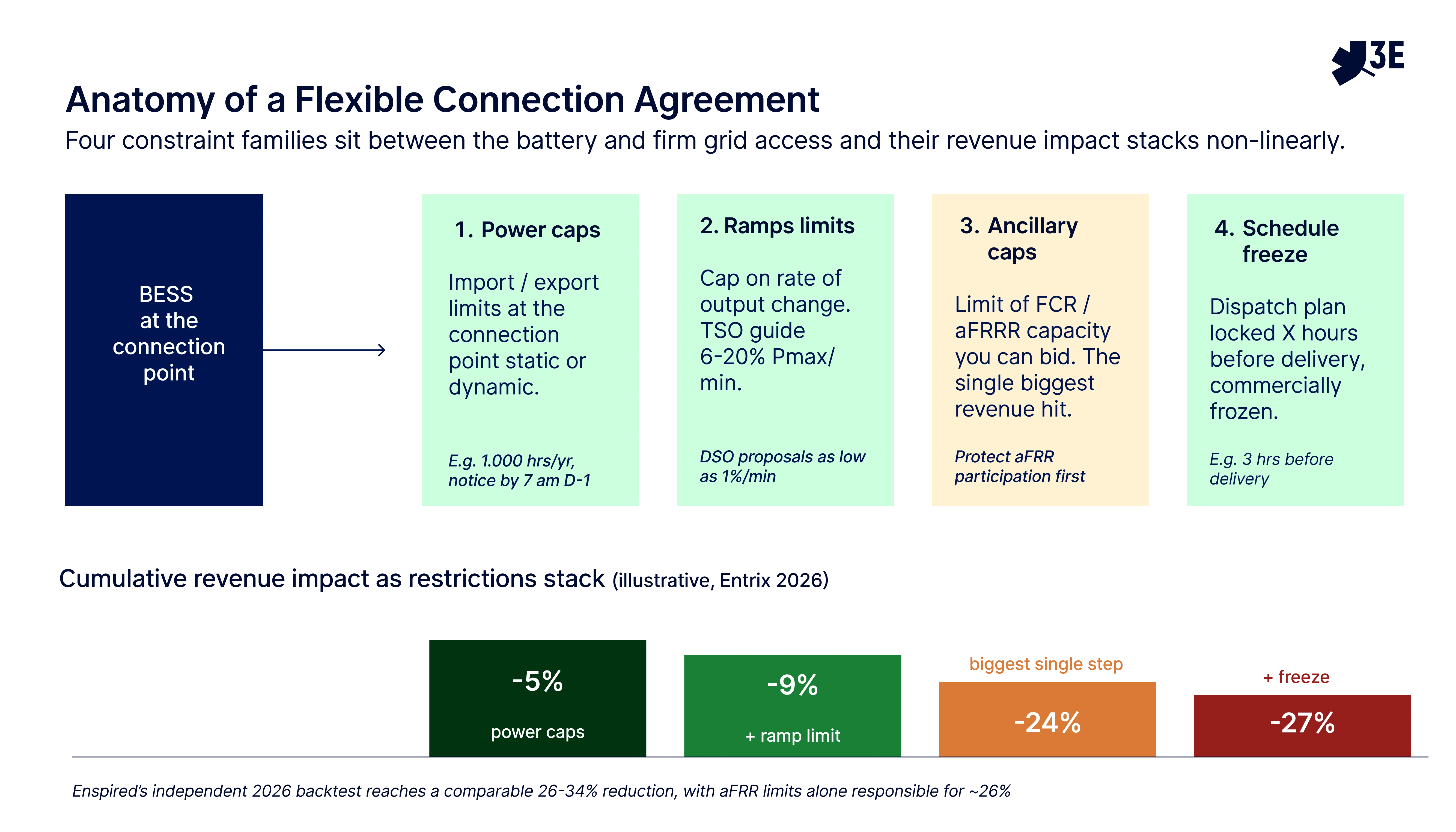
- Power caps — import/export limits on charge/discharge power at the connection point, static (always on) or dynamic (only when the network needs it).
- Ramp-rate limits — caps on how fast output can change. TSO guidance sits around 6–20% of Pmax per minute; some DSO proposals go as low as 1%/min.
- Ancillary-service capacity caps — limits on how much capacity you can bid into FCR and aFRR. This is the single biggest lever on revenue.
- Temporal dispatch-window restrictions — schedule freezes that lock the dispatch plan several hours before delivery.
The point most easily missed is that FCAs are bilateral and non-standardised. Their bespoke nature is arguably a greater risk than any single technical constraint, because the same limit can be benign or catastrophic depending entirely on how it was negotiated and how well the asset is run underneath it.
The revenue impact is real and concentrated
Two of Europe’s largest optimizers put hard numbers on FCA impact in 2026. One modelling exercise showed how each additional FCA restriction reduced a battery's revenue compared with an unconstrained project. A charge/discharge cap reduced revenue by around 5%. Adding a ramp limit increased the reduction to 9%. When an ancillary services cap was included, the impact rose to 24%, and adding a schedule freeze increased it further to 27%. An independent back test reached similar conclusions, estimating that FCA restrictions could reduce revenues by 26–34% compared with an unconstrained two-hour battery.
The critical insight for owners is where the damage concentrates. The single biggest step comes from ancillary-service caps, specifically limits aFRR participation. aFRR is the core value driver; FCR limits barely move the needle. The revenue-impact curve is flat above roughly 70% aFRR participation, then steepens sharply below it. Negotiators who instinctively protect FCR while conceding aFRR are trading away the wrong thing. The rule of thumb: protect aFRR first.
Impact is also event-driven. In an unconstrained battery, around half of annual revenue is earned in roughly 20% of the year. FCAs both increase dependence on those high-value windows and reduce the ability to capture them through freezes and ramp limit. That tension is exactly where operational quality decides the outcome.
The technical performance lens: where the value actually leaks
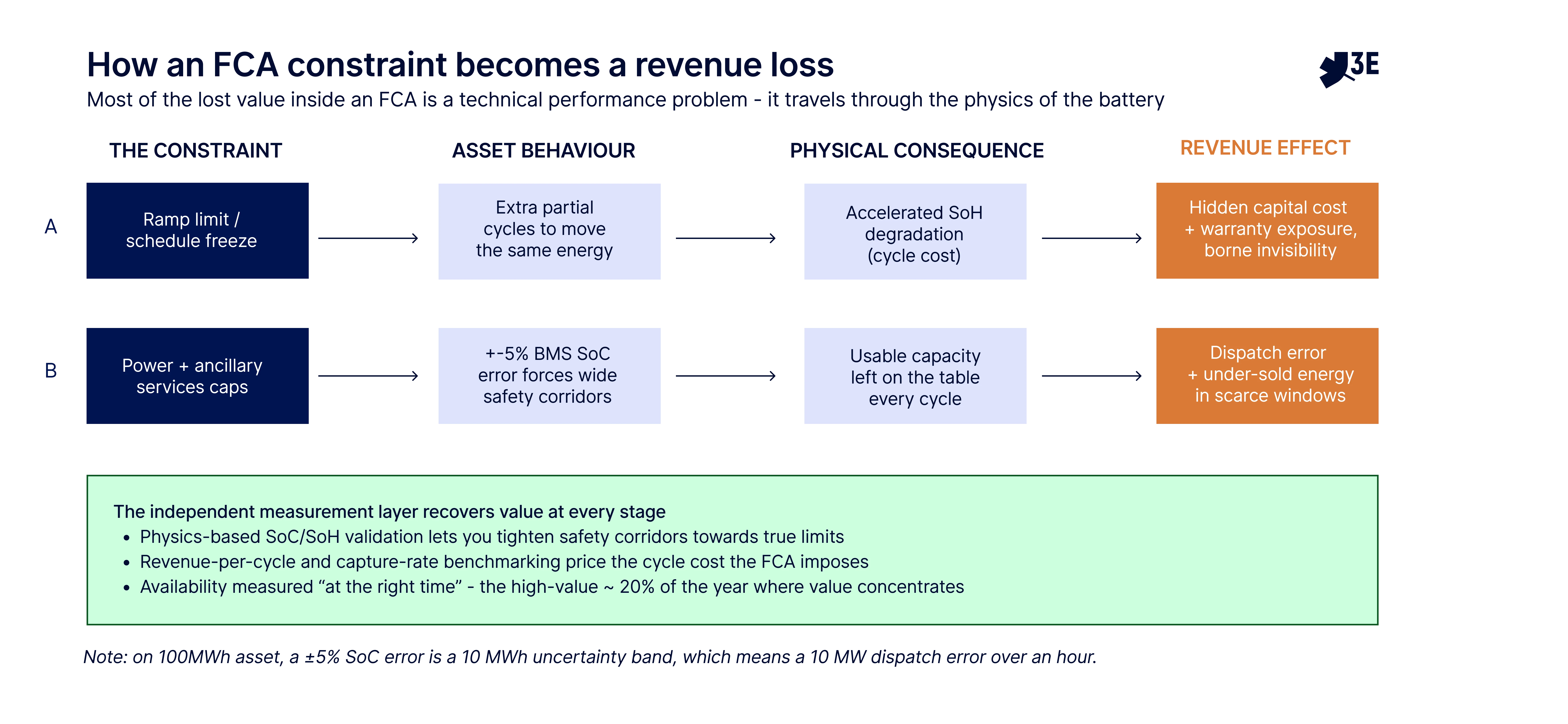
Here the conversation should shift from contract terms to asset behavior, because most of the recoverable value inside an FCA is a technical performance problem, not a legal one. The constraint travels through the physics of the battery before it ever shows up as a number in the revenue report.
Ramp limits and freezes change how the battery cycles
Tight ramps and schedule freezes don't just cap revenue; they change how the asset must work to hit the same commercial target. Holding a revenue or availability position under an FCA constraint tends to mean less efficient dispatch, wider time at high state-of-charge, more shallow cycling, and higher round-trip losses, therefore the asset accumulates more effective throughput and calendar-stress per euro earned. The full-equivalent-cycle count for a given energy volume may be similar, but the degradation cost of earning the same revenue rises, and it does so invisibly through accelerated State-of-Health (SoH) decline the owner bears alone. Cycle cost is systematically underweighted in optimization and almost never priced into FCA negotiations. Tracking revenue per cycle, and degradation per euro of revenue, gives a far more honest view of what an FCA costs the asset over its life.
SoC accuracy becomes more valuable, not less
Field data presented in 2026 showed BMS State-of-Charge accuracy is often only about ±5%, miscalibrated from commissioning. On a 100 MWh asset that is a 10 MWh uncertainty band, a 10 MW dispatch error over an hour. Traders respond by adding SoC safety corridors, deliberately leaving revenue on the table to protect warranties. Under an FCA, where you are already constrained on how much energy you can move and when, conservative corridors compound the loss. Independent, physics-based SoC validation lets an operator push those corridors closer to true physical limits with confidence, recovering revenue the constraint never actually required you to surrender.
Availability has to be measured at the right time
Under merchant operation, missed availability during a quiet hour barely matters. Under an FCA that concentrates value into fewer windows, availability at the right time, uptime during the high-value ~20% of the year, is the metric that decides the business case. So does capture rate: actual revenue against the theoretical maximum the market and your FCA envelope allowed. That comparison isolates genuine performance from market luck, and it is the only honest way to tell whether an FCA is being managed well or simply blamed for underperformance that better operations would have avoided.
Why Independent FCA Assessment Matters Commercially
The commercial dimension follows directly from the technical one. Lenders and tolling counterparties underwriting German BESS need the constrained revenue distribution, not just a constrained average, and they increasingly want it evidenced independently, rather than asserted by the optimizer grading its own homework. FCA terms are also sometimes tightened after Final Investment Decision, so owners need a live record of the envelope they committed capital against versus the one they operate under today. Clean, benchmarked, independent performance data is what turns an FCA from an opaque haircut into a managed, reportable line in the business plan.
How should IPPs protect their renewable energy business case
- Negotiate in the right order. Protect aFRR participation first; treat FCR caps as low-cost concessions; resist sub-6%/min ramps and short-notice, uncompensated charge/discharge restrictions.
- Price the cycle cost. Model the extra partial cycles a ramp limit or freeze imposes, and carry that degradation cost into both the negotiation and the business plan.
- Instrument before you sign and certainly before go-live. Independent SoC/SoH validation and a compliance record are cheapest to establish at commissioning, when baseline data is still clean.
- Benchmark continuously. Track capture rate, revenue per cycle, availability-at-the-right-time and SoH trajectory, so you can prove whether the FCA or the operation is the real constraint.
- Treat monitoring as the DSO translation layer. Standardised, independent performance data is exactly what an under-resourced grid operator can act on and gives you a stronger position when constraints are renegotiated.
Where this leaves the BESS asset stack
An FCA sits at the boundary between three systems that rarely speak the same language:
- the grid operator setting the constraint,
- the EMS or optimizer executing dispatch inside it,
- and the battery hardware whose true state determines what is safely possible.
An independent asset-performance layer sits above all three validating the battery’s real SoC, SoH and round-trip efficiency, benchmarking dispatch against what the market and the FCA envelope allowed, and translating technical behaviour into the revenue language owners, traders and lenders need.
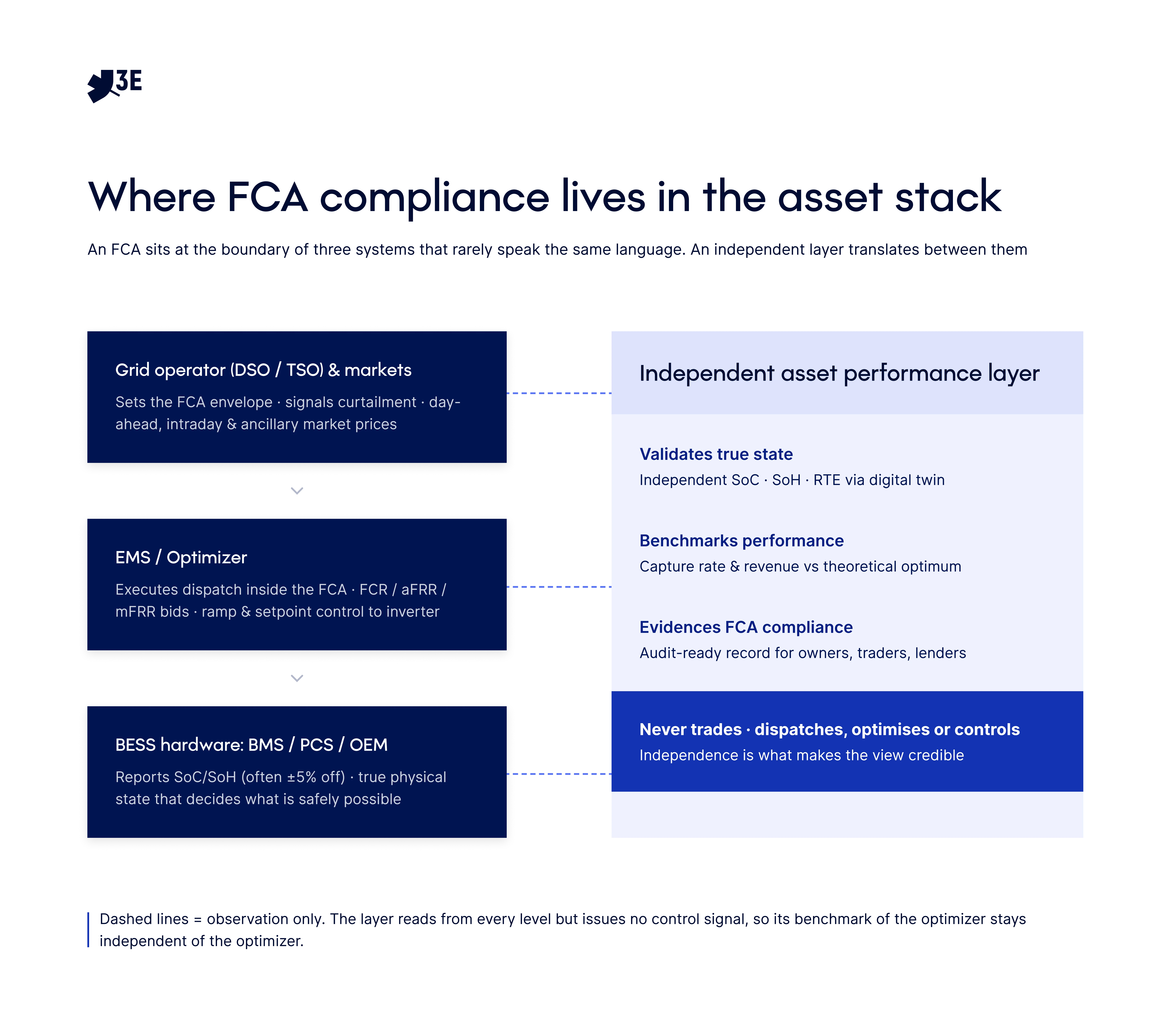
This is the role SynaptiQ, 3E’s hardware-agnostic asset performance management platform, is built to play. It sits above the EMS and OEM layers, runs an independent PyBAMM-based digital twin of every connected battery, and reports performance against theoretical optimum, deliberately without ever trading, dispatching or controlling the asset, so its view stays independent of the systems it measures. In an FCA-constrained market, that independence is the point: the operator who can see most clearly inside the constraint is the one who gives away the least.
Get in touch with us
Meet our experts to learn how FCA is impacting the German market and discover the insights we're already gaining through Synaptiq's ongoing monitoring.