
1. Keydata: Eneco & its hybrid project
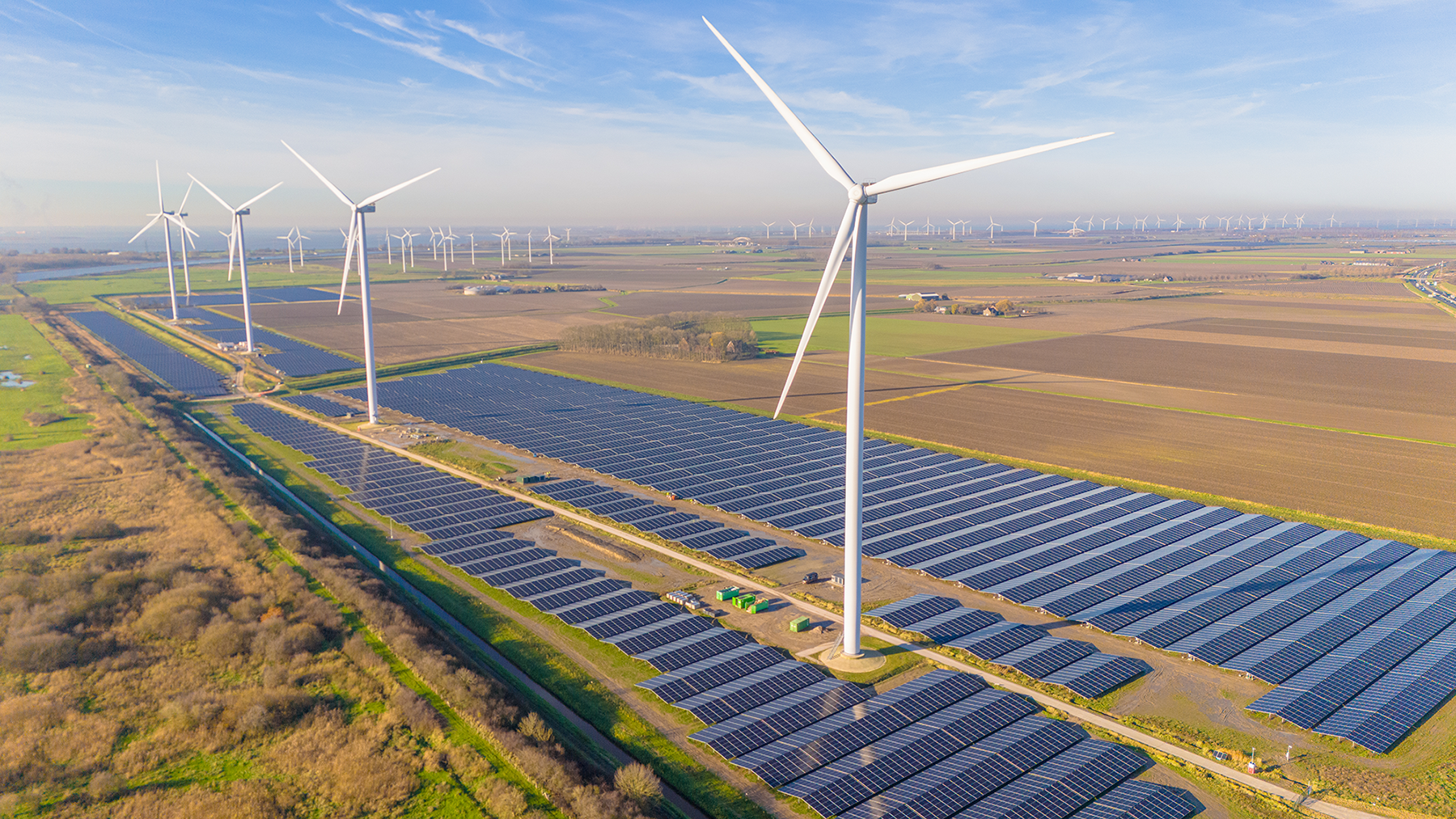
At the Dutch–Belgian border, Eneco’s Kabeljauwbeek site originally operated as a wind farm. As optimisation of existing infrastructure became more and more important, Eneco decided to add a solar PV installation to the existing wind asset. By combining wind and solar behind a single grid connection, Eneco aimed to better utilise available capacity, leveraging the complementary production profiles of both technologies.
Eneco
- IPP in solar, and offshore & onshore wind
- Active in The Netherlands, Belgium, Germany and the UK
- 5 million customers supplied
- 4,000 employees
The Kabeljauwbeek project
- Location: The Netherlands
- Initial installation: 14 MW & 18 MVA wind
- New extension: 24 MWp & 19 MVA solar
- Shared grid connection: 16.8 MVA
2. The challenge: operating a solar plant that is always curtailed
The Kabeljauwbeek project reflects a broader shift in renewable asset management: hybrid plants, grid congestion, and frequent curtailment fundamentally change how performance must be measured.
Curtailment became continuous
Historically, curtailment occurred occasionally. Eneco simply excluded curtailed periods from PR calculations. However, as curtailment became more frequent, this approach no longer reflected normal operating conditions.
Because wind and solar share a limited grid connection, solar output is continuously adjusted in real time to respect export limits. Curtailment therefore occurs throughout the day depending on solar & wind potential production and grid constraints.
As a result, the PV plant is rarely able to operate at full export capacity. Excluding curtailed periods from analysis was no longer meaningful, as it removed a significant part of normal operating conditions. This made increasingly difficult to accurately assess plant performance using traditional KPI methodologies.
Loss causes could not be identified
Following their traditional calculations, Performance Ratio (PR) deviations reached nearly –20%. However, Eneco could not determine whether these losses were caused by grid curtailment, weather variability, wind-solar interaction, commercial dispatch decisions or technical issues.
Hybrid operation complicated KPI reporting
The hybrid configuration introduced a new operational reality:
- Wind and solar share grid capacity.
- Solar is curtailed first due to subsidy structure.
- Curtailment signals are dynamic and continuous.
As traditional PR calculations were no longer suited to this operating model, the key question became how to quantify curtailment losses.
3. The SynaptiQ solution for quantifying curtailment
Digital twin simulation of expected production
Based on plant configuration, component characteristics and onsite sensor data, Eneco built a digital twin of the Kabeljauwbeek asset in SynaptiQ. This model simulates expected PV production under actual weather conditions, and provides a consistent baseline for performance analysis.
Integration of real-time curtailment signals
Curtailment controller setpoints are fed directly into SynaptiQ and are updated every 4 seconds. This allows Eneco to identify in real time when production is limited by grid constraints rather than by technical issues, including during partial curtailment.
Quantification of curtailment losses
Using the simulation model together with grid setpoints, SynaptiQ calculates how much energy is lost due to curtailment. Instead of removing curtailed hours, Eneco can now reconstruct the unconstrained production of the plant.
Full loss breakdown beyond curtailment
SynaptiQ Solar Analytics gives visibility into the root causes of more than 23 categories of losses: grid curtailment, soiling losses, string faults, RISO faults, snow, etc. It also distinguishes recoverable from non-recoverable losses. This helps Eneco avoid attributing all underperformance to curtailment and enables targeted O&M actions.
Corrected KPI reporting
Thanks to SynaptiQ, Eneco adjusted its internal reporting methodology. Curtailment losses are now added back to measured production, to recalculate PR and availability. Corrected performance is then compared against budget, which results into a performance evaluation more aligned with the actual operating constraints of the hybrid plant.
“With SynaptiQ we can clearly quantify the impact of curtailment and separate it from other performance losses. This gives us a full loss picture, allowing us to investigate underperformance in detail and take targeted action.”
Tom De Waele, Engineering & Realisation Manager at Eneco