Turning fragmented BESS signals into faster, more reliable decisions
Operators can improve alarm management in hybrid and energy storage portfolios by using a platform capable of centralising data from BMS, EMS and SCADA into a single operational view. On top of this, alarms must be structured into clear priority layers to ensure critical events are consistently surfaced and interpreted across the portfolio.
This approach transforms fragmented signals into actionable operational intelligence, improving response speed, early fault detection and portfolio-wide control.
To understand this better, this blog breaks down why BMS, EMS and SCADA systems are becoming insufficient at portfolio scale, how BESS & hybrid alarms should be prioritized, and how this logic is implemented in an intelligent alarm engine.
Why is managing BESS alarms so difficult at scale?
Every system produces more than enough information: the Battery Management System (BMS), Power Conversion System (PCS) error codes, Energy Management System (EMS), and on-site SCADA all continuously generate alerts, events, and status updates.
The challenge for most BESS operators and asset managers is that this information is fragmented, inconsistent, and overwhelming at scale. In practice, operators managing multi-site portfolios often face these questions:
- Which alarms actually require immediate action?
- How do I avoid missing critical issues in a flood of notifications?
- How do I prioritize alarms across a hybrid site where BESS, PV, and grid constraints are interconnected?
- How do I track contractual guarantees across multiple battery sites and technologies?
- How can I detect performance degradation early enough to prevent revenue loss?
- Why do I still need to jump between multiple vendor dashboards to understand what is happening?
These issues directly affect availability, compliance, and revenue performance across entire portfolios.
Why traditional BMS, EMS and SCADA systems don’t scale for portfolio-wide alarm visibility
At site level, BMS, EMS, PCS and SCADA systems work well on their own. A technician can interpret alarms directly from the BMS or EMS interface, understand context informally, and respond accordingly.
But at portfolio scale, these traditional systems create overlapping, duplicated, and sometimes contradictory signals. Each system applies its own data model, thresholds, timing logic, and severity classification rules.
- A BMS alarm is typically cell- or rack-level, highly granular, and safety-oriented.
- A PCS alarm is grid- and power-electronics-focused, often tied to AC-side behaviour.
- An EMS event is dispatch- or market-driven, reflecting external constraints rather than equipment health.
- SCADA aggregates data from multiple sources but does not prioritise alarms, resolve conflicts between sources, or optimise asset performance
Together, these fragmented alarm systems produce signals that are difficult to interpret consistently across assets and sites. For example, a “warning” in one system can correspond to a critical issue in another. At scale, manual interpretation of alarms directly leads to:
- Alarm fatigue and misinterpretation
- Delayed response times
- Missed early indicators of degradation
- Inefficient O&M workflows
This is why alarms from the different systems need to be organised within a shared operational hierarchy.
How to prioritize alarms across BESS and hybrid energy systems?
Effective alarm management is about prioritizing alarms according to operational criticality. In advanced BESS operations, alarms can be categorized across four functional layers.
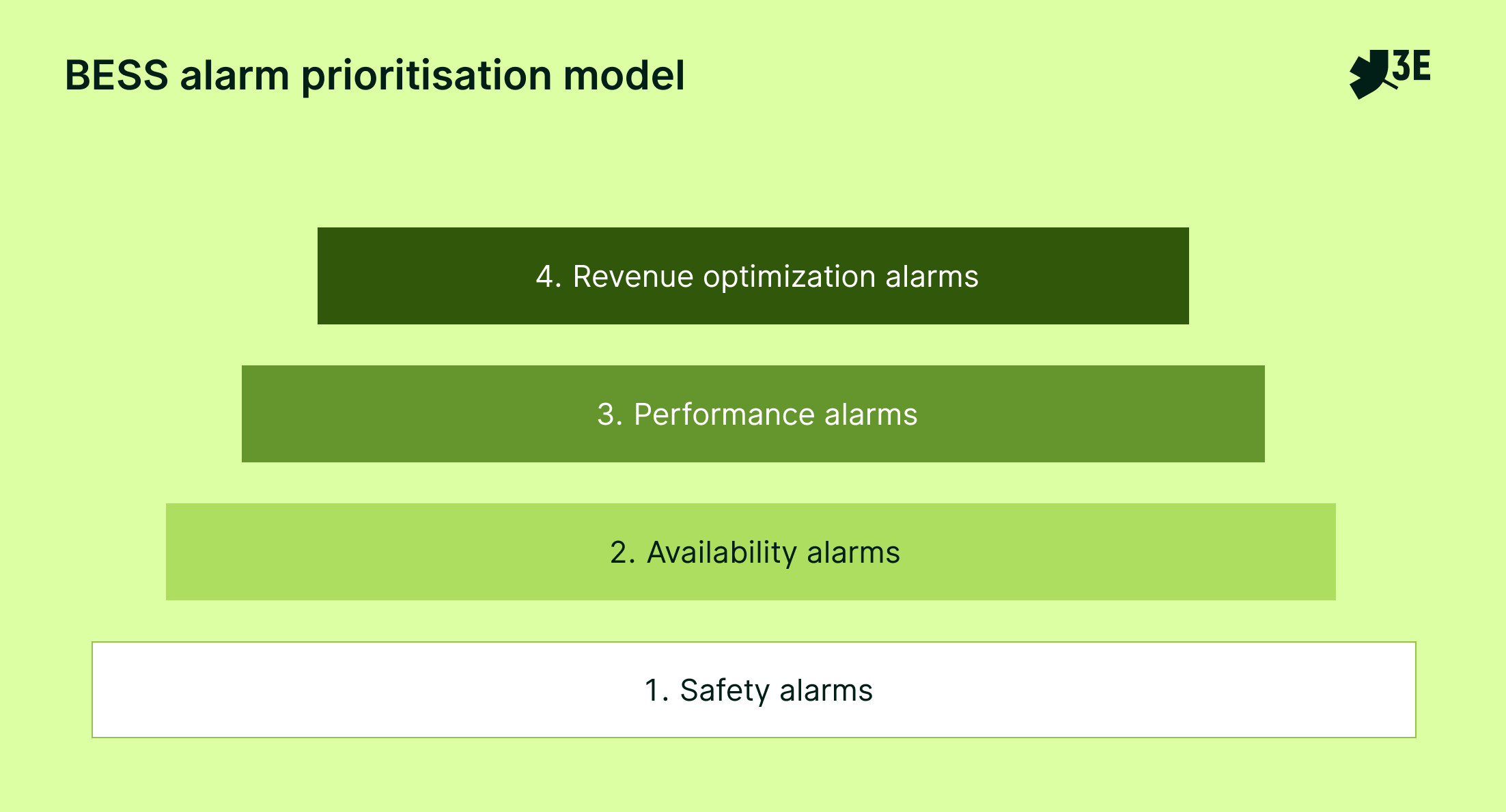
1. Safety: protecting the asset and preventing damage
Safety is the non-negotiable foundation of BESS operations. This layer includes alarms linked to:
- Cell and module temperature excursions
- HVAC (Heating Cooling and Air Conditioning) critical events
- Thermal runaway indicators
- Critical BMS fault conditions
These signals originate primarily from the BMS and are directly tied to physical risk. At this level, safety is a fundamental hardware challenge: sensors, contactors, thermal barriers, fire suppression systems and other protections form the first and only line of defense against events that escalate in seconds, not minutes. The software layer is important to enhance visibility, speed up reaction time and support root cause analysis.
If a safety alarm is triggered, operational optimization is irrelevant: the asset must be stabilised or taken offline immediately.
2. Availability: can the asset operate and respond to the grid?
Once safety is ensured, the next question is whether the asset is actually available. Availability alarms cover any condition that prevents a BESS from operating or responding to dispatch signals.
In hybrid portfolios, this challenge becomes more complex, as many availability losses originate communication issues between the BESS, solar, grid and market systems.
Availability alarms typically include:
- Communication loss between systems
- EMS or SCADA disconnection
- PCS or racks decoupling
- Forced outages or restart loops
Availability plays a critical role in BESS & hybrid portfolios as the business plan relies on the system being able to deliver energy at any given time. Any reduction in availability can impact revenue, both through missed opportunities and penalties for not meeting contractual capacity.
If an asset is unavailable, no level of optimisation or performance tuning can deliver value.
Note: While predictive maintenance can prevent some of these events, “black swan” failures can still occur. Sudden outages with no prior telemetry or warning signals cannot always be anticipated, but it is essential to have an alarm engine capable of identifying them.
3. Performance: is the asset behaving as expected?
When an asset is safe and available, operators can focus on performance. This is where imbalance and degradation signals become critical. Performance alarms highlight:
- Rack cell imbalance
- Capacity drift across modules
- Charging/discharging inefficiencies
- Early signs of accelerated degradation
These are often subtle signals, but they are among the most important indicators of long-term asset health. Traditional BMS/EMS might lack the system perspective and history to detect these issues.
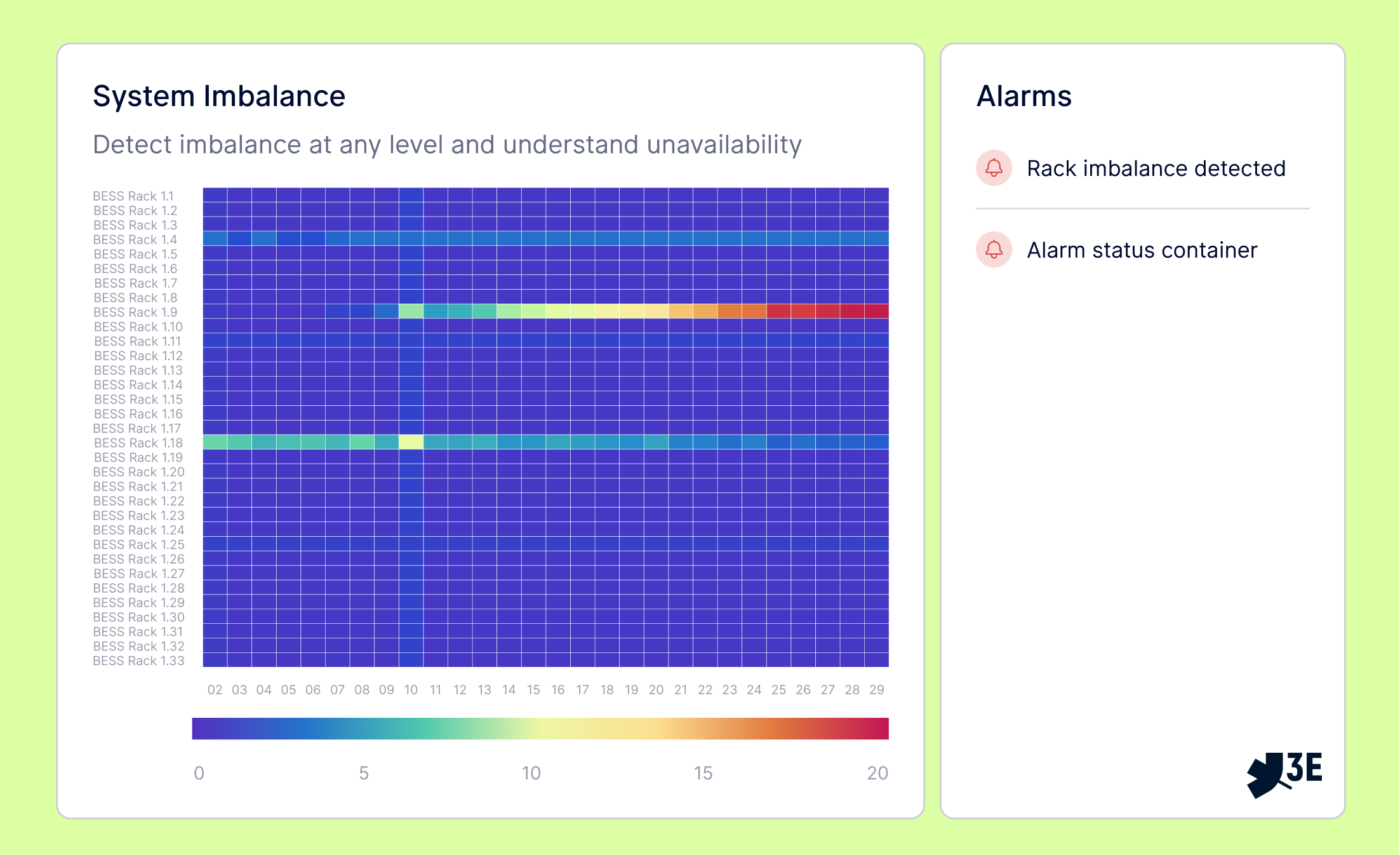
Left unaddressed, performance issues can reduce usable capacity and significantly impact lifetime revenue, creating a growing mismatch between expected and actual available capacity that can lead to trading penalties or missed market opportunities. A strong performance layer should enable operators to detect these trends early before they become irreversible or they have a significant monetary impact.
4. Revenue optimization: protecting contractual performance
At the revenue optimisation layer, BESS and hybrid assets must comply with contractual obligations. This includes:
- Curtailment events
- Setpoints compliance, grid and market signals
- Energy throughput guarantees
- Availability commitments
- Contract-specific KPIs across multiple sites and counterparties
In practice, managing guarantees manually across a diversified portfolio is extremely complex. Each site may operate under different contractual frameworks, and deviations are not always visible in real time. Without a structured system, financial penalties can accumulate without early warning, often discovered too late in reporting cycles.
Market optimization also fits into this layer: ensuring the asset is dispatched in a way that maximizes revenue without violating contractual limits. This requires aligning operational decisions (cycling, throughput and availability windows) with commercial constraints.
This is why guarantee tracking must be treated as an active alarm layer, not a passive reporting exercise.
At this level, the goal is simple: protect revenue, avoid penalties, and ensure the asset delivers on its financial promise.
How an intelligent alarm engine operates across hybrid and energy storage systems
A hierarchical alarm structure is necessary but not enough. Value comes from how this logic is implemented in the day-to-day operations of Asset Managers, O&M and Control Room operators who need a consistent way to structure, prioritise, and act on alarms across BESS or hybrid portfolios.
SynaptiQ’s BESS alarm engine is designed to transform fragmented signals into a unified operational system. It does this through these specific capabilities:
Unified data ingestion across different sources and technologies
Instead of treating each system separately, SynaptiQ centralises all incoming data streams into a single normalised layer. This removes vendor dependency at the monitoring level and ensures that all alarms are interpreted within a consistent framework, regardless of hardware or protocol differences. The end goal of this is a single hybridized list with multiple asset types.
Contextual intelligence for focused operational insights
As explained earlier, one of the biggest challenges in BESS monitoring is the excess of insights and the noise all data and alarms can create. SynaptiQ addresses this through:
- Aggregation of related alarms into a single reporting level to facilitate root cause and simplify workflows.
- BMS alarm harmonization to enable a consistent alarm list across multiple vendors, select only the relevant events and avoid noise.
The result is fewer, but more meaningful, operational alerts.
Hierarchical alarm prioritisation
All incoming signals are automatically classified into different types of alarms. Some of them follow a simple logic based on threshold while others have a more complex behaviour using a dedicated BESS object model and digital twin. Here are the 3 main categories:
- Operational alarms (near real-time control room monitoring) ensure SLA compliance and high asset availability. They are highlighted in the ‘Focus alarms’ section.
- Imbalance and analytics alarms (performance intelligence layer) detect early signs of unperformance and serve as warning before potential downtimes or significant reduced capacity.
- Guarantee alarms (contractual KPI tracking) enable asset managers to minimize liquidated damages and penalties.
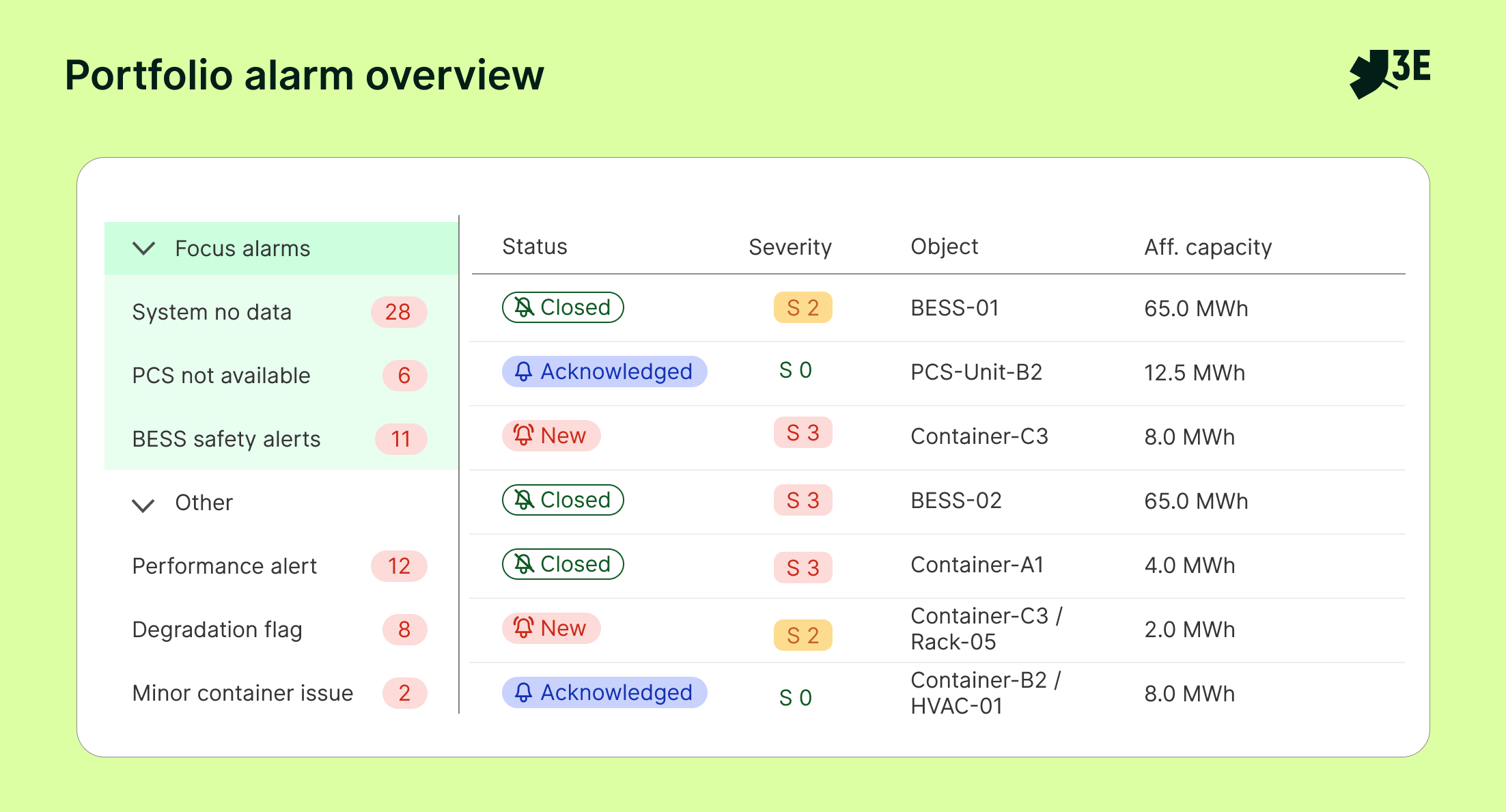
Our alarm engine routes alarms according to the hierarchy explained earlier (safety > availability > performance > revenue optimization), ensuring that safety and availability events always surface first, and that lower-priority notifications do not mask critical signals. This also helps not mixing the duties of Control Rooms and Asset Managers, while keeping a portfolio overview of all alarms.
Configurable escalation and workflow integration
Different assets, teams, and contractual structures require different response pathways. SynaptiQ enables configurable escalation flows that align with site-level O&M teams, central control rooms, asset management teams and external stakeholders or contractors.
This ensures that the right people are notified at the right time, without requiring custom system builds per site.
Auditability and operational traceability
Every alarm interaction is logged end-to-end, including when the event occurred, how it was classified within the system, who responded to it, what actions were taken, and what the outcome of the incident was.
This creates a complete operational audit trail that is essential for warranty validation, regulatory compliance, and investor reporting.
Beyond storage: why hybrid portfolios require unified alarm intelligence
Today’s energy portfolios increasingly combine solar PV, battery storage, grid constraints and market dispatch logic. In this setup, alarms from different systems cannot be interpreted independently.
A thermal anomaly on a BESS system looks different when you can see that the co-located PV array has been operating at curtailed output for three days. An availability event reads differently when you understand the broader grid conditions the asset was responding to. Integrated monitoring does not just consolidate data, it generates insight.
SynaptiQ addresses this by connecting solar, storage and grid signals into a unified monitoring view where alarms are automatically correlated and interpreted in context. This translates into operational impact:
- Critical events surface immediately
- Performance degradation is detected earlier
- Contractual risks become visible and manageable
- Hybrid portfolios can be operated as a single system, not fragmented assets
While hybrid portfolio management also relies on analytics, reporting and optimisation workflows, these functions only perform reliably when supported by a unified alarm intelligence layer.
From fragmented alarms to operational intelligence
In short, we recommend operators to work within a centralized environment where signals from BMS, EMS and SCADA are correlated, prioritised and acted on consistently.
If you want to see how this approach is implemented for managing energy storage and hybrid systems, why not booking a demo of SynaptiQ?