
The challenge: from platform migration to operational transformation
Managing a rapidly expanding international fleet with diverse hardware and legacy configurations, Mexens (at that time called Technique Solaire) needed a scalable, automated supervision model capable of supporting long-term growth. But migrating an entire operational fleet, while maintaining business continuity, required restructuring workflows, introducing automation, and validating data quality across hundreds of plants simultaneously.
Scaling supervision with a small team
Mexens needed to migrate 1,100 operational plants within 4 months using a supervision team of only 4 people. Manual configuration methods were incompatible with the required migration speed and future portfolio expansion.
Fragmented data and operational limitations
The existing ecosystem relied on heterogeneous data loggers, inconsistent metadata, and low-quality irradiation data. Without a structured Digital Twin, teams spent significant time performing manual corrections instead of focusing on performance optimization.
Preparing for future growth
Beyond migration, Mexens sought a long-term operating model enabling automated onboarding, portfolio-wide analytics, and standardized configurations across multiple countries and technologies.
The solution
Mexens selected SynaptiQ to build an automated supervision ecosystem centered on APIs, standardized data, and configuration validation.
API-first migration and deployment
Mexens industrialized its migration by using the SynaptiQ API as the central deployment engine. Instead of manually creating plants, the team built scripts connected to a unified internal data model that automatically created, configured, and validated assets in SynaptiQ. Migration was executed in controlled weekly batches, allowing plants to be integrated safely while maintaining supervision continuity. This transformed migration from a manual effort into a repeatable automated workflow.
Unified data architecture for scalable operations
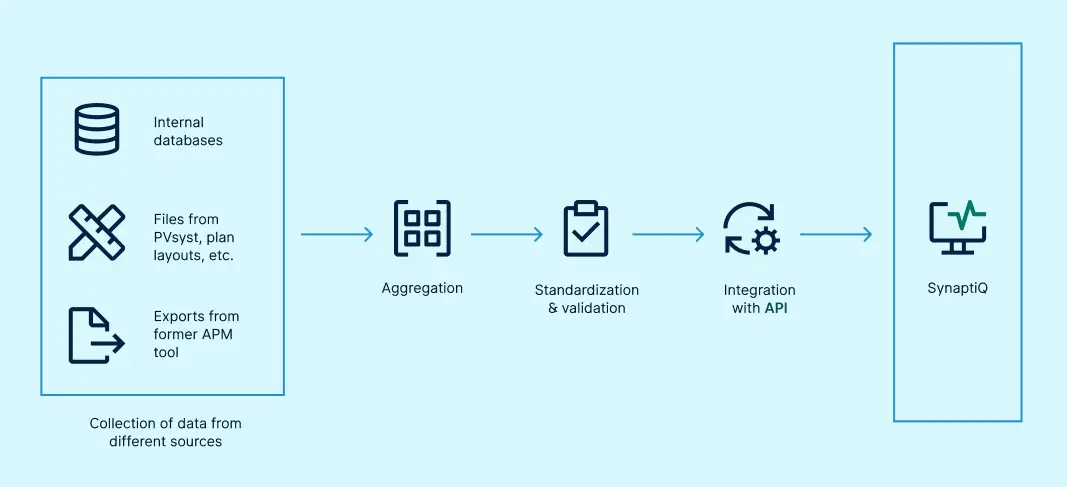
All trusted data sources (internal databases, PVsyst engineering files, and legacy platform exports) were consolidated into a single standardized dataset before integration. By pushing only validated information into SynaptiQ, Mexens established one operational source of truth. This approach reduced onboarding time dramatically, cutting plant integration from roughly 20 minutes to only 5 seconds per site.
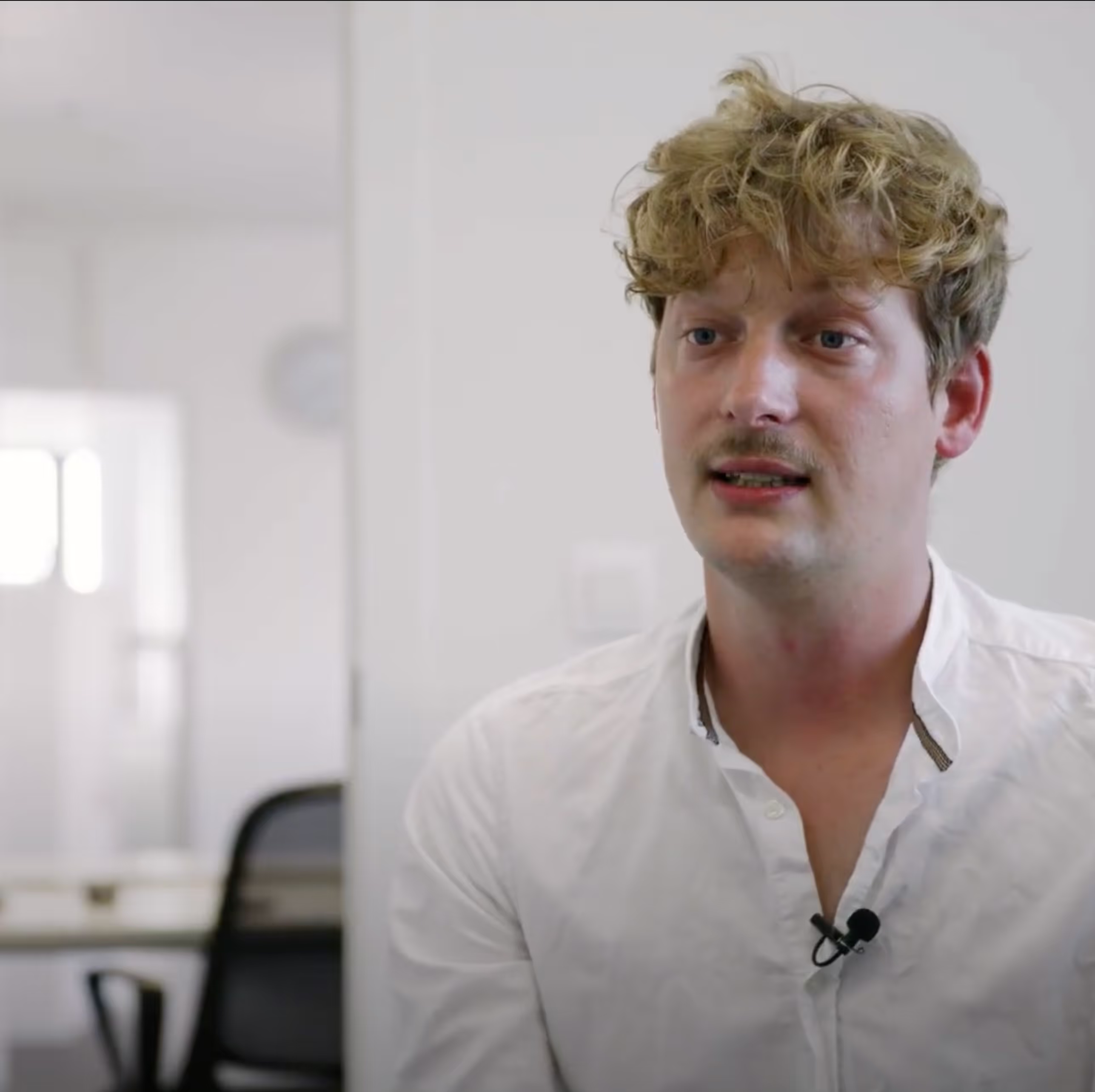
"By connecting our systems directly to SynaptiQ via the API and structuring our data upstream, we transformed what could have been a complex migration into an industria-lised process.
Today, automation and a reliable Digital Twin allow us to scale our operations, focus on performance analysis, and significantly reduce manual workload."
— Thomas Dhuicq, Head of Supervision, Mexens
Advanced Digital Twin configuration and validation
To ensure the data configured into SynaptiQ were complete and accurate, Mexens integrated 3E’s Configuration Check into the migration workflow. The tool assessed site data integrity based on existing configurations and leveraged 3E’s Solar Analytics simulation model to refine each plant’s Digital Twin.
In addition, the Configuration Check enabled to integrate the DC tree information that was not available in the previous platform or in the as-built designs. It provided an estimation of how strings, DC inputs and modules are configured. These inputs were used to establish the initial configuration of all the sites.
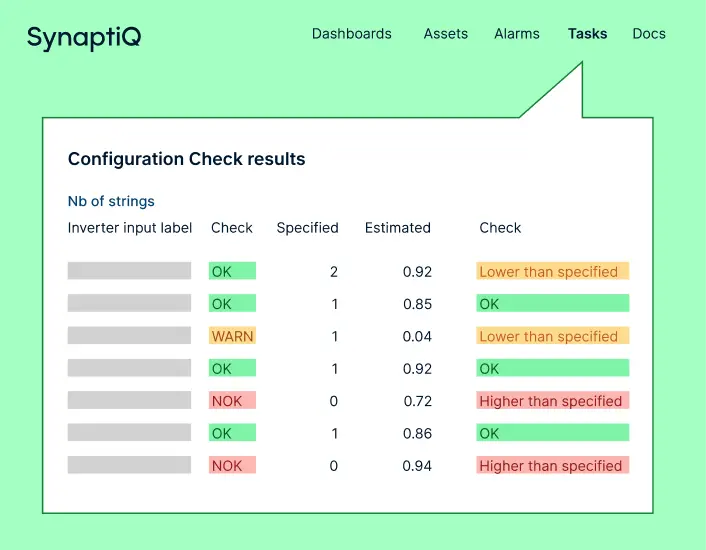
This iterative process allowed them to set up DC monitoring functionalities, such as deviation and performance alarms, losses waterfall and root cause failure identification, with recommendations for recoverable losses.
With advanced and verified configuration data, teams could test changes safely, detect inconsistencies early, and maintain high data quality across the entire fleet.
"3E’s Configuration Check can easily retrieve input and MPPT-level information from our inverters. This allows us to detect inconsistencies in the DC structure and recover missing configuration details. In practice, this capability enabled us to reconstruct DC tree information and deploy DC monitoring on sites where it was previously unavailable."
— Thomas Dhuicq, Head of Supervision, Mexens
Portfolio automation powered by SynaptiQ API
After migration, the API became the foundation of daily operations. Plants are now onboarded automatically at commissioning, portfolio-wide updates can be executed in a single controlled action, and continuous pre-checks prevent incorrect data from entering the system. Automation enables Mexens to verify, correct, and align its entire fleet at scale without increasing operational workload.
"In four months, with only four people, we migrated around 1,000 plants. The API-first approach made migration and automation possible. Now we can integrate new assets faster and apply changes across the entire fleet safely."
— Thomas Dhuicq, Head of Supervision, Mexens